|
|
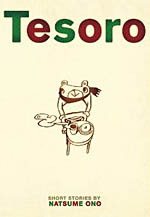
By Natsume Ono 248 pages, black and white Published by Viz
Natsume Ono is a comic creator who, much to her credit, has no problem leaping from one subject to the next; one minute it’s samurai stories like House of Five Leaves, the next it’s romantic drama at a restaurant, or a young man trying to figure out questions of family and identity. I was delighted as a result to find out about Tesoro, a collection of Ono’s short stories. In doing so I found confirmation that while the plots are often different, there are definitely some threads that run through her works.
Ono writes a lot about loss and family. Missing parents are often elements in these shorts, and it’s to Ono’s credit that each character feels different in their own way, no matter what they’re going through similar to ones in different stories. Even when there’s no particular loss, like in "Froom Family," Ono still understands the hold that family members have on one another; there’s no way that young Nils could get the same amount of anguish from people that weren’t his sisters, able to get under his skin just so. Italy also crops up several times here, a favorite setting of Ono’s, but she often uses it as little more than a backdrop. Ono’s enchantment and fascination with the country none the less rubs off on the reader; I’d have expected to start groaning, "Oh no, not another story set in Italy" but instead I found myself hoping for one more glimpse. My favorite piece in the book, though, is probably "Three Short Stories About Bento." The three stories have little connection other than being about the Japanese lunch boxes, but each of them managed to both give a glimpse into Japanese culture and also bring their characters to life better than some full-length books I’ve read. Add in Ono’s trademark scratchy, loose-lined style, and you end up with a charming sampler from Ono. With 14 stories, even if you (like myself) find a small number to not quite be up to par, there’s more than enough here to keep you entertained for quite some time.
Purchase Links: Amazon.com | Powell’s Books

By CLAMP 584 pages, black and white Published by Viz
X is a strange little duck in the manga world, in terms of its publication history. Created by the four-person creative collective CLAMP, X began in Japan in 1992, but was halted in 2003 as it neared its conclusion due to concerns by the publisher over the "increasingly violent stories." Meanwhile, in North America, due to Dark Horse Comics’ series X, its publication by Viz ran under the name X/1999, referencing the pivotal year in which the series was set. It’s now 2011 and CLAMP hasn’t found a new publisher in Japan to run the final chapters of X, but the series is now coming back into print in North America in a series of 3-in-1 omnibuses, and under its original title of X. As the comic focuses around the apocalypse, saying "the end is near" is extremely appropriate no matter how you look at it. And based on what I found in X 3-in-1 Vol. 1? I am a little boggled at the idea how just how violent these later chapters must be.
Read the rest of this entry »
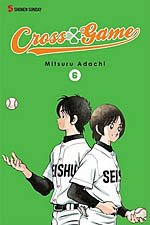
By Mitsuru Adachi 376 pages, black and white Published by Viz
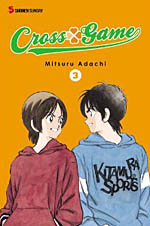
I’m normally not into reviewing a series again right after tackling the previous release. So after reviewing Cross Game Vol. 1-2, I figured it would be safe to wait a few volumes before bringing it back up. But by the time I was done with Cross Game Vol. 3, I was so struck by the direction of the series that I found that I couldn’t wait any longer. In short, I feel like Mitsuru Adachi gets just as frustrated at other long-form series as I do, and took steps here to show that he’s not going to fall into that same trap.
Read the rest of this entry »
Written by Hyung-min Kim Art by Kyung-il Yang 192 pages, black and white Published by Viz
A lot of people have become a bit obsessed with starting at the beginning of a series, or nowhere else at all. It’s not exclusive to comics, either; the number of people who won’t jump on board to a television series without seeing all the previous episodes is a prime example. But lately, I’ve found myself increasingly curious on seeing how well a series holds up if you don’t begin with the first volume. So when I came upon the second volume of March Story, I decided to give it a whirl even though I’ve never read the first book. Quite frankly, I’m glad that I did.
Read the rest of this entry »
By Rumiko Takahashi 200 pages, black and white Published by Viz
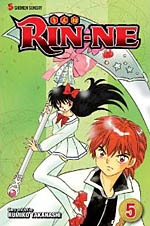
I’ve been having fun reading brand-new chapters of Rumiko Takahashi’s series Rin-ne on the Shonen Sunday website each week; for those who like something a little more permanent, though, the book is also being published in a series of collections. (Doubly so since once the collections are released, the individual chapters come off of the official site.) Picking up the latest volume, it strikes me that while I’m enjoying the series overall, in some ways this feels like a slight step backwards for Takahashi.
Read the rest of this entry »
By Mitsuru Adachi 576 pages (v1) & 376 pages (v2), black and white Published by Viz
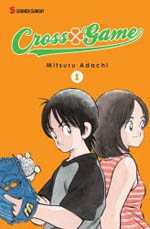
First, a quick point that I need to bring up: I’m not a fan of baseball. Watching it on the television just does nothing for me, and while I have a good time at the occasional trip to the ballpark with friends, it has to do with the experience (and getting a chili cheese dog and a beer) rather than the game itself. I mention this not because I think it’s any sort of superior viewpoint (I’m actually a little envious of my friends who love it), but because you need to know that before I tell you the next fact. Cross Game, Mitsuru Adachi’s comic about high school students playing baseball, is now probably one of my favorite manga series of all time.
Read the rest of this entry »
Written by Tsugumi Ohba Art by Takeshi Obata 200 pages, black and white Published by Viz
When I first started reading Tsugumi Ohba and Takeshi Obata’s Bakuman last year, I was almost instantly intrigued by the glimpse into the manga publishing world, and getting a look into the mechanics of pitching to and being published by the big leagues. Through the eyes of two high school students, Ohba and Obata looked to be making a fictionalized version of, "How the publishing industry works." As Bakuman has progressed, though, what we’re starting to get now is something even more interesting—most notably a question of what happens when you try and become more "commercial" in your comic-creating.
Read the rest of this entry »
By Yoshinori Natsume 200 pages, black and white Published by Viz
The first volume of Kurozakuro performs a rather effective fake-out on its reader. Its first 50 page chapter sets its reader’s expectations up on just what sort of comic Kurozakuro will be, letting everyone imagine how the rest of the series will slowly unfold. And then, just when you’re convinced of the status quo, the second chapter rolls along and cheerfully proves you wrong and sends the book zipping down a different, more interesting path. That’s the kind of fake-out I approve of, wholeheartedly.
Read the rest of this entry »
By Usamaru Furuya 256 pages, black and white Published by Viz
Usamaru Furuya’s Short Cuts is one of the strange, off-beat comics that Viz published in its PULP anthology back in the day, and which you still hear its fans talk about in hushed tones. It was silly, irreverent, and unpredictable, and a feature I always looked forward to. I’d never seen a comic longer than a one- or two-page gag strip by Furuya before, though, so Genkaku Picasso being translated into English felt like perfect timing. What I wasn’t expecting, though, was a bizarre mixture of "special powers to help others" mixed with pop psychology.
Read the rest of this entry »
By Takehiko Inoue 192 pages, black and white Published by Viz
I am rapidly running out of comics by Takehiko Inoue to read. When the next volume of Real is published in November, the translations will have caught up to the series in Japan. And while I have the last couple volumes of Vagabond stashed in reserve for a rainy day, once again the series in English is about to catch up to the series in Japanese. So, after quite a few years, it seemed like a good a time as any to read an older series from Inoue that’s being translated, his other basketball comic: Slam Dunk. Having read his more recent works as of late, going back to Slam Dunk feels a little surprising in places.
Read the rest of this entry »
|
|